
One thing that stands out these days, as social media promotes "nature," is how loud…
Overview: Devil’s Lake State Park was recently ranked by WorldAtlas among the state parks with the highest tick-borne illness risk in the country, but the ranking needs some context. Sauk County does have a significant Lyme disease problem, and the reasons go well beyond deer alone. Mice, invasive Japanese barberry, acorn crops, predator relationships, and changing forest conditions all play a part in why blacklegged ticks do so well here.
You may have seen the headline making the rounds recently: WorldAtlas ranked Devil’s Lake State Park #5 on its list of state parks with the most tick-borne illness. [Read Here]
Wisconsin news has been running with it, and at first glance, it sounds pretty bad. But the ranking needs a little context.
WorldAtlas isn’t saying that Devil’s Lake has the fifth-highest number of people actually contracting Lyme disease inside a state park. The article looks more broadly at tick-borne disease in the surrounding region, along with documented tick activity, habitat, reported infections, and other factors. For Devil’s Lake, it points to Wisconsin’s high rate of Lyme disease, the park’s mix of wooded trails and open habitats, and the sheer number of people who visit each year.
So maybe take the ranking itself with a grain of salt. But don’t dismiss the story out of hand, either.
Lyme Disease Is Common in Wisconsin

We certainly do have Lyme disease here.
According to reporting in the Wisconsin State Journal, Sauk County falls in a range of 101 to 200 reported Lyme disease cases per 100,000 people. That’s high, although it isn’t the highest rate in Wisconsin. Vilas and Oneida counties, for example, fall into a range of 301 to 684 cases per 100,000.
There is also an important limitation to county statistics like these. Wisconsin DHS tracks Lyme cases by the county where the person lives, not necessarily where the tick bite occurred. So these numbers shouldn’t be read as a count of infections picked up specifically at Devil’s Lake, or even necessarily within Sauk County.
Statewide, the larger trend is pretty clear. Wisconsin reported 6,469 Lyme disease cases in 2024, the highest number on record. The state averaged about 4,600 cases per year from 2019 through 2023, and reported Lyme incidence has quadrupled over the past 20 years.
So yes, we have a lot of ticks around here. But what is really interesting is why.
First, About Those “Deer Ticks”
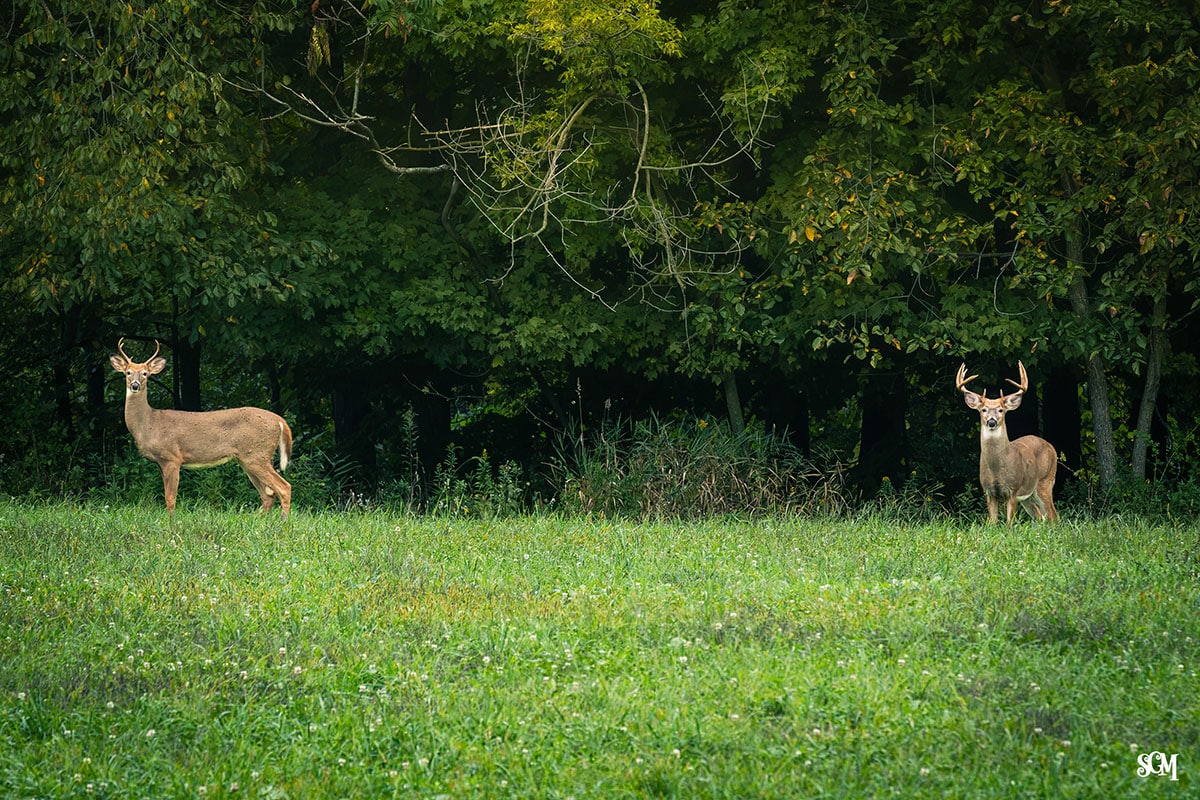
The tick we’re talking about is the blacklegged tick (Ixodes scapularis), although most of us grew up calling it the deer tick. And deer certainly matter. Adult blacklegged ticks commonly feed on white-tailed deer, so deer provide an important host and help support tick populations.
But here’s the part that often gets missed: deer aren’t particularly good reservoirs for the bacteria that causes Lyme disease.
Now mice, on the other hand…
White-footed mice and some other small mammals can be very effective reservoirs for Borrelia burgdorferi, the bacterium responsible for most Lyme disease infections. Larval ticks feed on mice and other animals. If they feed on an infected host, they can acquire the bacteria and later, as nymphs, may pass it on to us.
A long-term study published in 2026 made this distinction especially interesting. At the study sites, the abundance of nymphal blacklegged ticks was much more closely connected to earlier white-footed mouse populations than to deer abundance. (Linked below)
That doesn’t mean deer don’t matter. They do. It just means the ecology behind Lyme disease is more complicated than simply having a lot of deer.
Japanese Barberry Makes Things Better for Ticks
Here’s another connection you may not know about.
Japanese barberry is a thorny invasive shrub that was widely planted as a landscaping plant and has now spread into forests throughout Wisconsin. Around the Baraboo Hills, it can form thick patches in the forest understory that are miserable to walk through and difficult for native vegetation to compete with.
They can also be pretty good places to be a tick.
Dense barberry creates a sheltered environment near the ground where humidity stays higher and ticks are less likely to dry out. Wisconsin DNR specifically notes that research has found higher rates of Lyme-carrying ticks in forests invaded by Japanese barberry.
And deer play another role here too. White-tailed deer generally avoid eating barberry because of its spines while continuing to browse many of the native plants growing around it. That gives barberry another competitive advantage and helps it become even more dominant in the forest understory.
So now we have deer, ticks, mice, and an invasive landscaping shrub all interacting in ways that can influence Lyme disease risk.
And we’re not done yet.
Even Acorns Can Matter
If the number of acorns hitting the ground around my place in the Baraboo Hills this fall is anything to go by, this could be an interesting acorn year.
That matters for more than squirrels.
Large acorn crops can support larger populations of white-footed mice and other small mammals the following year. Those animals, in turn, provide hosts for larval ticks. The effect doesn’t happen immediately. Long-term research has documented a general pattern of heavy acorn production followed by increased mouse populations the next year, followed by increased numbers of ticks another year later.
So if we really are seeing a big acorn crop around the Baraboo Hills in 2026, it won’t explain the ticks we’re seeing today. But it is something worth watching over the next couple of years.
Then There Are Foxes and Coyotes
Predators add another interesting wrinkle.
Coyotes and red foxes overlap on the landscape, but they don’t always use it in the same way. Where coyotes become established, foxes may shift toward the edges of coyote territories or into areas coyotes use less.
That can matter because foxes eat a lot of mice and other small mammals.
Research has explored whether expanding coyote populations can indirectly affect Lyme disease by suppressing fox populations. Fewer foxes could mean less predation on mice and other small mammals that serve as hosts for ticks and Lyme bacteria.
There is still debate about exactly how large that effect is, and it would be much too simple to say that coyotes “cause” Lyme disease. They don’t. It’s also not an argument that we should simply start removing coyotes. Predator relationships are complicated, and changing one population can create effects somewhere else that weren’t expected.
But that’s really the point.
There Isn’t One Cause of Our Tick Problem
It would be convenient if there were.
Too many deer? Fix the deer. Too many mice? Fix the mice. Too many ticks? Kill the ticks.
Ecology generally doesn’t work that way. Our current tick problem is a bunch of things coming together. Deer, mice, invasive plants, forest conditions, predators, food supplies, climate, and changes to the landscape all interact with one another. And meanwhile, we’re hiking right through it.
That doesn’t mean you should stay out of Devil’s Lake or the surrounding forests. But it does mean you should pay attention.
Tick Season Isn’t Over in Fall
Tick activity generally peaks during the warmer months, but Wisconsin DHS notes that tick exposure can occur throughout the year and that ticks can be active whenever temperatures are above freezing. Early fall is still very much tick season.
A few basic precautions go a long way. Stay toward the center of trails when possible and avoid brushing through tall grass and other vegetation along trail edges. Use an effective tick repellent. DEET or picaridin can be used according to label directions, and clothing, shoes, and outdoor gear can be treated with products containing permethrin.
Check yourself carefully after hiking, particularly around the waist, behind the knees, around the hairline, and other places ticks can easily go unnoticed. And don’t forget the kids and dogs.
Devil’s Lake being placed fifth on somebody’s national list makes a good headline, but the more interesting story is why ticks have become so successful in the landscape around us.
And that story involves a lot more than deer.
References
WorldAtlas, The State Parks With The Most Tick-Borne Illness
https://www.worldatlas.com/state-parks/the-state-parks-with-the-most-tick-borne-illness.html
Wisconsin State Journal, Devil’s Lake / Sauk County Lyme disease reporting
https://madison.com/news/state-regional/article_eaf0103e-d149-503c-9aed-cdb875651c58.html
Wisconsin Department of Health Services, Lyme Disease Data
https://www.dhs.wisconsin.gov/tick/lyme-data.htm
Wisconsin Department of Health Services, Environmental Public Health Tracking / Lyme disease data details
https://www.dhs.wisconsin.gov/epht/data-details.htm
Wisconsin DNR, Japanese Barberry
https://dnr.wisconsin.gov/topic/Invasives/fact/JapaneseBarberry
* Long-term research on acorns, white-footed mice and blacklegged tick abundance
https://pmc.ncbi.nlm.nih.gov/articles/PMC13505984/
Research on coyotes, red foxes and Lyme disease ecology
https://pmc.ncbi.nlm.nih.gov/articles/PMC3390851/
Wisconsin Department of Health Services, Tick Bite Prevention
https://www.dhs.wisconsin.gov/tick/bite-prevention.htm
Do Possums Eat Ticks? True or False, Birds & Blooms
https://www.birdsandblooms.com/gardening/backyard-wildlife/do-possums-eat-ticks/

For over 30 years, the Skillet Creek blog has focused on 3 main goals: to inspire you to visit and explore the Devil’s Lake region, to help you get the most out of your visit by sharing tips, events, and other helpful information. Lastly, to advocate for our environment & wildlife and talk about how we can keep our natural areas amazing now and into the future! That last goal can sometimes cause controversy, but it’s the only way we can accomplish the first two. – Derrick Mayoleth, Owner.
Related Posts

Comments (0)