
As I sit down to write this morning, the Cornell Lab’s BirdCast Migration Dashboard estimates…

Overview: It’s that time of year when the fall color predictions start coming in, and for 2026 there are plenty of reasons to predict everything from an early, muted autumn to a late and colorful one. Wisconsin has had drought, heat, and a warm start to September, but exactly how those conditions will affect fall color depends on where you are, the health and species of the trees, and most importantly, what the weather does next. Here in the Devil’s Lake State Park Region, we’ll continue to watch what is actually happening on the ground and report each week on where the best color can be found.
Every September we start seeing the predictions. Wisconsin’s fall colors will be spectacular. Drought will make them muted. Color will come early. Warm weather will push everything late. And, as usual, there is some truth behind most of them.
The problem is that fall color is complicated enough that you can take one part of the weather story and come up with a perfectly reasonable prediction that turns out to be wrong.
So what are people saying about fall color in Wisconsin this year?
Drought Could Matter
The Wisconsin State Climatology Office is probably the best place to start. Their September climate summary points to the dry conditions that developed across Wisconsin this summer, particularly in northern parts of the state, and says drought stress is likely to affect the timing and vibrancy of fall color in some areas.
That makes sense. Trees under serious drought stress may begin shutting down early, change color sooner than expected, turn brown or simply drop their leaves.
But drought doesn’t necessarily mean that the whole state turns early.
The UW Arboretum in Madison is seeing an interesting example of that this year. Some stressed trees began showing fall color weeks ago, while the majority of healthier trees are expected to change later than normal. Their current prediction for the Madison area puts peak color into late October and possibly even the first week of November.
So, yes, drought may make some trees turn early while the broader forest turns late.
Welcome to fall color forecasting!
Warm Weather May Slow Things Down
Wisconsin also came out of a warmer-than-normal summer, and the Wisconsin State Climatology Office entered September expecting temperatures to lean warmer than average. Its broader autumn outlook also gives Wisconsin a somewhat increased chance of above-average temperatures through September, October and November.
Warm temperatures, particularly warm nights, can delay the normal process of fall color development.
The basic trigger is still the shortening day. Trees know autumn is coming because the amount of daylight is decreasing. But temperature, moisture and tree health all influence what happens from there.

The Wisconsin DNR notes that the strongest red colors tend to develop with a run of warm, sunny days followed by cool nights that stay above freezing. Reds are produced differently from the yellows and oranges we see in autumn, which are already present in the leaves and become visible as chlorophyll disappears.
That’s worth remembering whenever you see predictions that this year’s colors will be “muted.”
The reds may certainly be affected by weather, but yellows, golds and oranges tend to be more consistent from year to year. A season with fewer brilliant red maples doesn’t necessarily mean we’re going to have a brown autumn.
And, of course, the weather that may ultimately decide all of this hasn’t happened yet.
A couple of weeks of sunny days and cool nights could improve the show. Warm nights may continue to hold things back. A hard freeze can end color quickly. Strong wind and heavy rain can take leaves off trees that looked wonderful the day before.
Which is why predicting the quality of fall color in September has always involved a bit of educated guessing.
So When Will Wisconsin Reach Peak Color?
Travel Wisconsin’s Fall Color Report currently has color progressing first across northern Wisconsin, as we’d expect, with much of central and southern Wisconsin forecast for later in October.
Here around Devil’s Lake, their current forecast lists the Baraboo area for the third week of October and Devil’s Lake State Park for the fourth week of October.
There is a big asterisk with those particular predictions, however.
As of September 22, both the Baraboo and Devil’s Lake entries are still based on reports entered back on August 18. So while those dates are useful as an early estimate, I wouldn’t start scheduling vacation days around them just yet.
Travel Wisconsin’s reports are actually a good illustration of just how variable autumn can be across the state. As of this week, some northern locations are already reporting noticeable color while many locations farther south are still showing very little change. Peak predictions stretch from late September in parts of the north into late October and even early November farther south.
Historically, that’s generally the pattern. Northern Wisconsin goes first, central Wisconsin follows, and southern Wisconsin comes later. The State Climatology Office notes that the typical season begins reaching peak in northern Wisconsin around late September and progresses into southern Wisconsin through mid-to-late October.
That’s useful for planning.
But it’s still only the big picture.
Fall Color in the Baraboo Hills
Here in the Baraboo Hills and nearby Driftless region, things get more complicated.
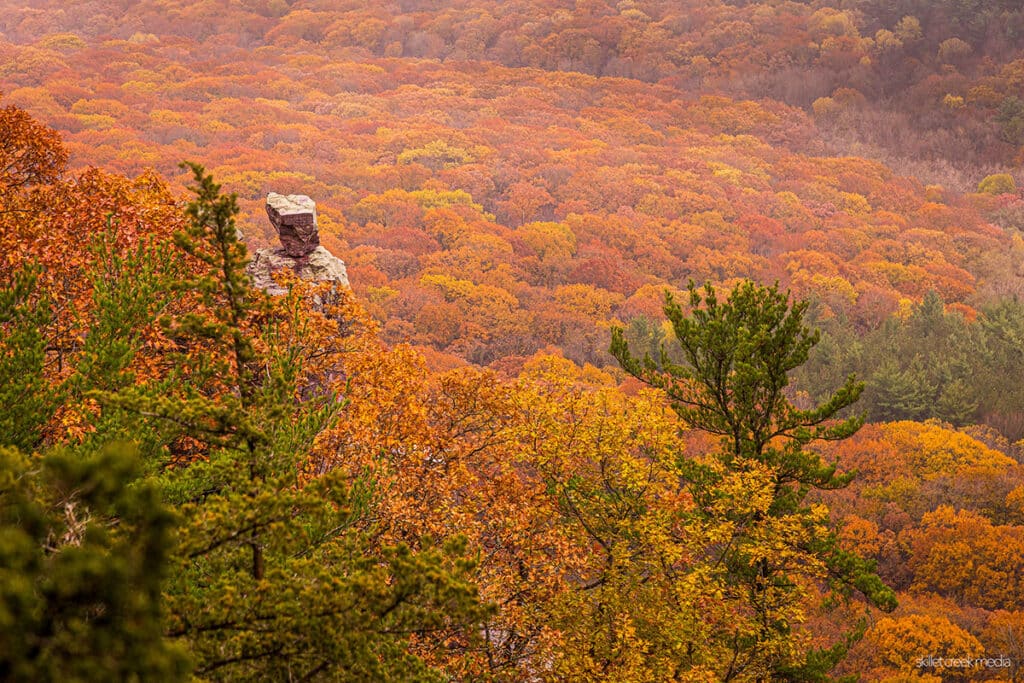
We have a landscape of hills, valleys, rocky bluffs, river corridors, deep ravines, and different exposures to sun and wind. Put all of that together, and you create a lot of small microclimates.
A deep, cool gorge such as Parfrey’s Glen can be moving into autumn while more open areas nearby remain largely green. (And from my visit this week, I can say that it is going yellow faster than the surrounding hills.) A north-facing wooded slope can behave differently from an exposed south-facing bluff. Cold air settles into valleys. Soil moisture changes dramatically over surprisingly short distances.
Then add the trees themselves.
Red maples tend to be among the first trees to show strong color. Sugar maples, hickories, and other species follow on their own schedules, while the oaks often carry us well into the later part of the season.
So when someone says Devil’s Lake is “25 percent color,” that can only tell you so much.
Twenty-five percent might mean there’s a lot of scattered color across the landscape. Or it could mean most of the park is still green while a few pockets are absolutely beautiful.
And if you’re coming here for a hike, photographs or family portraits, that difference matters.
That’s Where Our Reports Come In
We can certainly give you a general window for peak fall color, and as we get closer we’ll keep adjusting that estimate based on what we’re seeing.
But we’re also trying to answer another question:
Where does it look good right now?
That’s really the advantage of reporting fall color from here instead of simply looking at a statewide map.
There may be very little broad color around Devil’s Lake, but three maples beside a particular trail might be glowing red and make a perfect setting for a family photograph.
One section of the park may still look like summer while another trail has moved well into autumn.
Later in October, someone may tell you that peak color is over, but there may still be a sheltered valley, an oak-covered bluff or a stretch of road that looks beautiful. For instance, the park’s entrance road usually peaks about a week after the rest of the park.
That’s the sort of information we want our weekly reports to provide.
We’ll still talk about percentages and give you our best estimate for the broader peak. But we’ll also be out looking at Devil’s Lake State Park, the Baraboo Hills and surrounding natural areas each week, watching where things are changing first and where the best color can actually be found.
Because “peak” is useful if you’re looking at Wisconsin from a distance.
Once you get here, autumn is a lot more local than that.
So What’s Our 2026 Fall Color Prediction?
Right now?
There are good reasons to think drought will affect some trees. There are good reasons to think warmth may delay the broader season. Northern Wisconsin is already beginning to change, while much of southern and central Wisconsin still has quite a ways to go.
And the weather over the next few weeks still gets a vote.
So we’ll stick with the prediction we’ve made before when everyone starts worrying that fall color might be disappointing:
It’ll probably be meautiful. Meaning, even if it’s dry and some folks are predicting muted colors, we know that in the right spot, with the right trees, and the right climate, you’re going to find some amazing color. Promise.
We’ll let you know what that looks like each week.

For over 30 years, the Skillet Creek blog has focused on 3 main goals: to inspire you to visit and explore the Devil’s Lake region, to help you get the most out of your visit by sharing tips, events, and other helpful information. Lastly, to advocate for our environment & wildlife and talk about how we can keep our natural areas amazing now and into the future! That last goal can sometimes cause controversy, but it’s the only way we can accomplish the first two. – Derrick Mayoleth, Owner.
Related Posts


Comments (0)