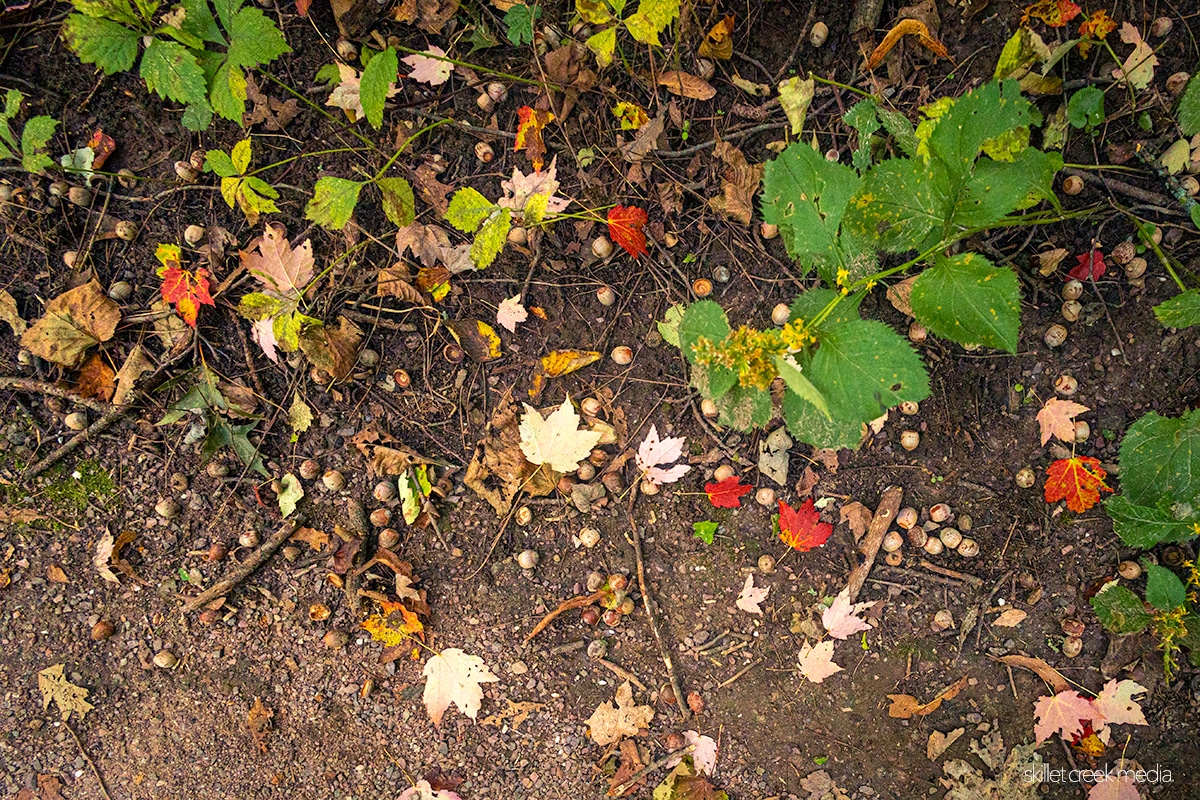
Overview: There are a lot of acorns falling around Devil’s Lake and the Baraboo Hills…

Mud Season at Devil’s Lake State Park
Updated March 2026.
Spring at Devil’s Lake State Park in Wisconsin usually means wet trails. Snowmelt and rain settle into the low spots, especially where thousands of boots have already compacted the soil. That’s normal this time of year.
What causes lasting damage isn’t the mud itself. It’s when hikers step around it.
When people avoid a puddle, they press into the grass and leaf litter along the edges. Roots get exposed. The soil loosens and sinks. The next group widens the path a little more. You can often trace where the trail used to be by the strip of bare ground spreading outward from the original tread. What began as a narrow wet stretch becomes a wide, churned section that holds even more water the next time it rains.
You can see this clearly on heavily traveled routes, especially on Steinke Basin and parts of the East Bluff.
Why Walking Around Mud Damages Trails
Trails often become low points over time because repeated foot traffic compacts the soil. Water settles into those depressions after rain or snowmelt. That part is expected. What expands the damage is repeated traffic outside the original tread.
Once the edges are disturbed, erosion accelerates. The ground stays soft longer. The muddy section grows instead of drying in place.
What often follows is trail braiding. One path becomes two. Two become three. Vegetation between them disappears, and the soil compacts into a wider, lifeless strip that sheds water instead of absorbing it.
Thin soils on the bluffs don’t recover quickly. In some places, the plants that once held everything in place may take years to return, if they return at all. Bare ground also gives opportunistic species an opening.
In the end, the environment becomes sick, and the landscape becomes ugly.
Walk Straight Through
If you care about Devil’s Lake, Parfrey’s Glen, Pewit’s Nest, or other natural areas in Sauk County, stay on the trail.
That means walking straight through the puddle.
Yes, your boots may get wet. Trails are built to handle foot traffic. The plants beside them are not. A muddy pair of boots lasts a day. A widened trail can last for years.

Shared Responsibility for Spring Trail Conditions
Trail maintenance is shared work between park staff, volunteers, and visitors. When downed trees, damaged steps, or drainage problems push people off the main tread, erosion spreads quickly. Reporting hazards helps prevent larger damage later. Speaking up when that work isn’t being done is also up to you.

Muddy boots tell the story
Leave No Trace isn’t abstract here. Trampling vegetation widens trails. Widened trails erode. Recovery can take years in thin soils and on steep slopes.
Staying on the path, even when it’s wet, protects the places you came to see.
If your boots are muddy at the end of the day, you probably did it right.

For over 30 years, the Skillet Creek blog has focused on 3 main goals: to inspire you to visit and explore the Devil’s Lake region, to help you get the most out of your visit by sharing tips, events, and other helpful information. Lastly, to advocate for our environment & wildlife and talk about how we can keep our natural areas amazing now and into the future! That last goal can sometimes cause controversy, but it’s the only way we can accomplish the first two. – Derrick Mayoleth, Owner.
Related Posts