
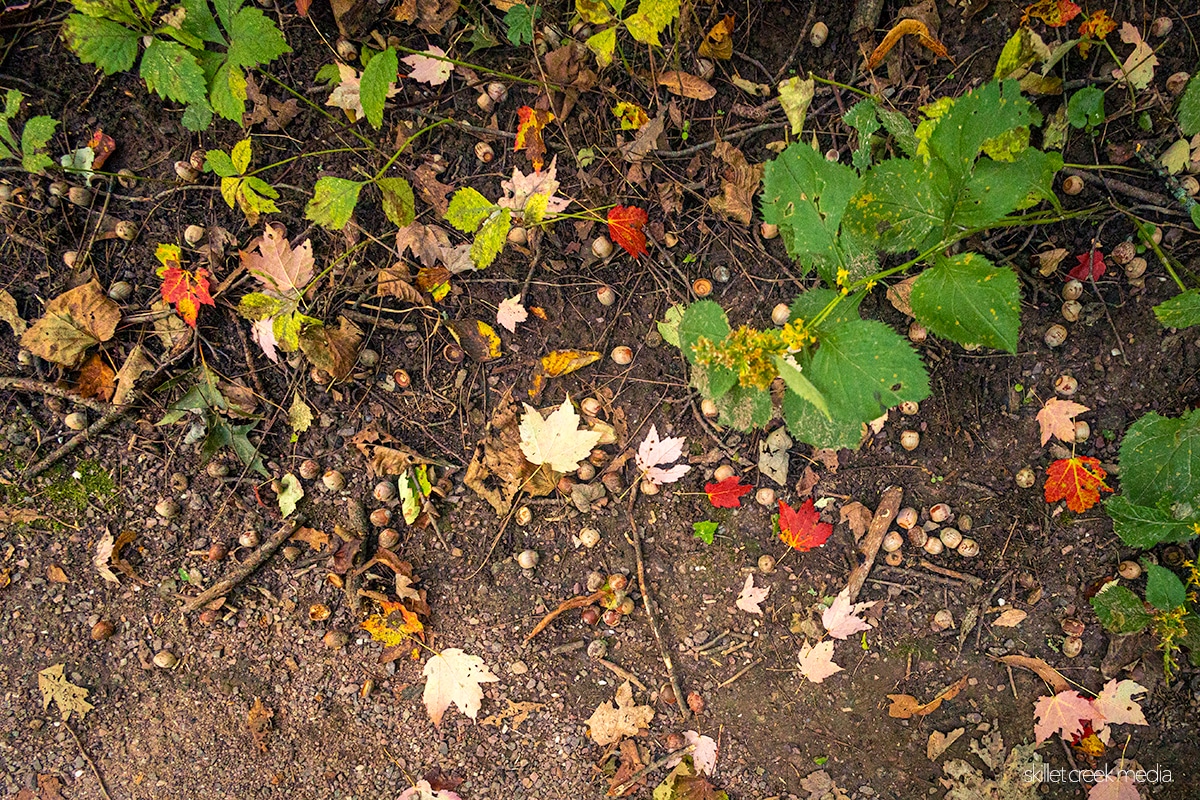
Overview: There are a lot of acorns falling around Devil’s Lake and the Baraboo Hills…

Updated Sept 22, 2026 – Overview: Black walnut season arrives in early fall around the Baraboo Hills. They’re edible, you can collect them for personal use on Wisconsin state properties, and getting from that big green husk to the actual walnut takes a bit more work than you might expect.
Among the many autumn memories I have, collecting black walnuts is, well, a mixed bag.
As kids, we’d be sent across the road from our grandmother’s house with much-too-large work gloves and onion bags to collect black walnuts from a line of trees along the road. Eventually, we’d come back stained in black and smelly, carrying as many nuts as our little kid arms could carry.
If that’s a fall memory you’d like to have, but you don’t have any walnut trees nearby, you can collect them in Wisconsin State Parks too.
Collecting Wild Edibles In Wisconsin State Parks
Yep, you can collect edibles such as fruits, nuts, and mushrooms in Wisconsin State Parks and natural areas without a permit, as long as you’re collecting them by hand for your own personal consumption. That includes black walnuts. (NR 45.04) Here’s some official info.
However, there are limits on what you can collect from public lands, so this isn’t a general invitation to gather plants, flowers, roots, rocks, or whatever else catches your eye. When it comes to walnuts, though, gathering a few for yourself is allowed.

Black Walnut Season
Black walnuts generally ripen around September and October. You’ll usually start seeing them dropping from the trees as the big green husks begin to soften.
And then comes the work.
Black Walnuts Make You Work For it!
The thing about black walnuts is that they are not like the big, fancy English walnuts you buy from the store. (Well, originally from the Middle East…) The black walnuts we collect around here demand a lot more work before you can enjoy them.
First, you have to find a tree and pick ’em. You’ll also find a lot on the ground, but you’ll want to collect them while they’re still in good shape. Then you have to remove the big smelly husks. Some say it’s a pine or citrus smell.
And this is where those work gloves become important.
Black walnut husks stain just about everything they touch, including your hands. In fact, walnut husks have historically been used as a dye.
Next, the nuts will have to be washed, dried out, and then cracked with something like a hammer. They work best in recipes and are not really the sort of nut you put out on the table for guests.
The University of Illinois Extension has a good step-by-step guide to collecting and preparing black walnuts if you want to give it a try.
Have fun.
And remember, wear gloves, or good luck washing your hands!

For over 30 years, the Skillet Creek blog has focused on 3 main goals: to inspire you to visit and explore the Devil’s Lake region, to help you get the most out of your visit by sharing tips, events, and other helpful information. Lastly, to advocate for our environment & wildlife and talk about how we can keep our natural areas amazing now and into the future! That last goal can sometimes cause controversy, but it’s the only way we can accomplish the first two. – Derrick Mayoleth, Owner.
Related Posts

Comments (1)
Comments are closed.
Our neighbor has a walnut tree that hangs over our fence and we have loads of squirrels. Lotsa black slimy walnut husks in the yard and a lot of holes dug. The little tree rats pretend to bury the nuts all over the place. I’ve never seen as many as this year… I guess the nutmeat is good but way too much work!