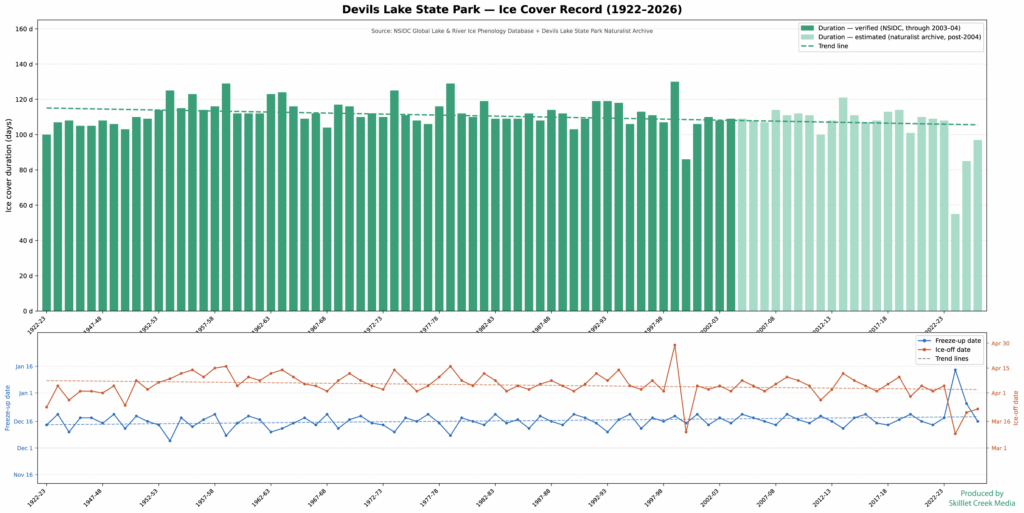
Nearly a century of ice records at Devils Lake tells a clear story: the ice season is shrinking, and the change is measurable from both ends.
The record spans 84 seasons from 1922 to 2026. Through 1979, no recorded season fell below 100 days. Since 1980, four have occurred, including the three shortest in the entire record. The 2023-24 season lasted just 55 days, less than half the length of a typical season from the mid-20th century.
The longest season on record was 130 days in 1998-99, when ice held through April 28. Before 1980, seasons of 120 days or longer occurred seven times in 38 seasons. Since 1980, that has happened twice in 46 seasons.
The average ice season ran about 113 days before 1980. Since then, the average has dropped to approximately 108 days. The more recent naturalist-gathered data from 2004 to 2026 shows a further decline to about 105 days per season.
The three shortest seasons on record all occurred in the past three years. The five latest freeze-up dates in the record include four from 2008 or later, with the most recent being Jan. 14, 2024, the only January freeze-up ever recorded in this dataset.
One limitation worth noting: the freeze-up date reflects when the lake fully freezes over, not the full pattern of winter ice behavior. In recent years, partial freezes followed by thaws and refreezes have become more common. The dates alone likely understate how much winter ice conditions have changed.