
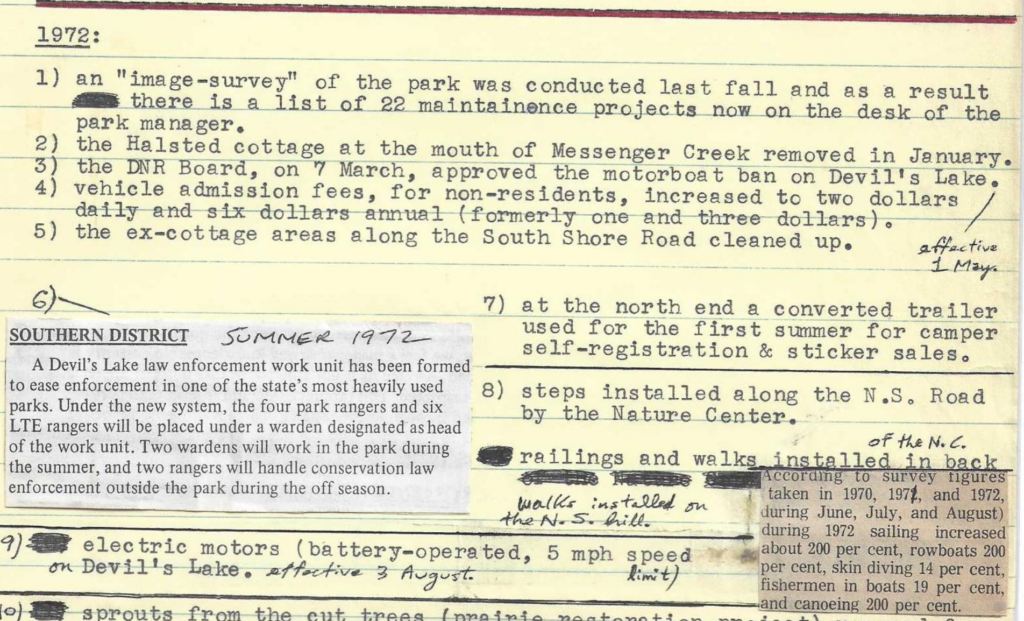
Motorboats were banned on Devil’s Lake on May 1, 1972. The Wisconsin DNR Board approved the prohibition on March 7, 1972, with an effective date of May 1. Both dates are recorded in the contemporaneous notes of Ken Lange, Devil’s Lake State Park’s naturalist at the time.
Later that same year, the DNR permitted battery-powered electric motors on the lake, effective August 3, 1972, with a strict 5 mph speed limit. The combustion motor ban and the electric motor allowance were separate decisions, both documented in Lange’s 1972 notes.
That restriction remains current law. Wisconsin Administrative Code NR 45.11(6)(a) restricts Devil’s Lake to battery-powered electric motors operating at slow-no-wake speed — no faster than 5 mph. The rule in effect today is a direct continuation of the 1972 board decision.
Why you still see motors on the lake
The ban has never meant no motors, period. It means no recreational combustion motors.
Electric trolling motors have been permitted since August 1972. Many visitors bring pontoon boats and larger craft onto the lake and simply run them on electric trolling motors at no-wake speed, which is legal and common.
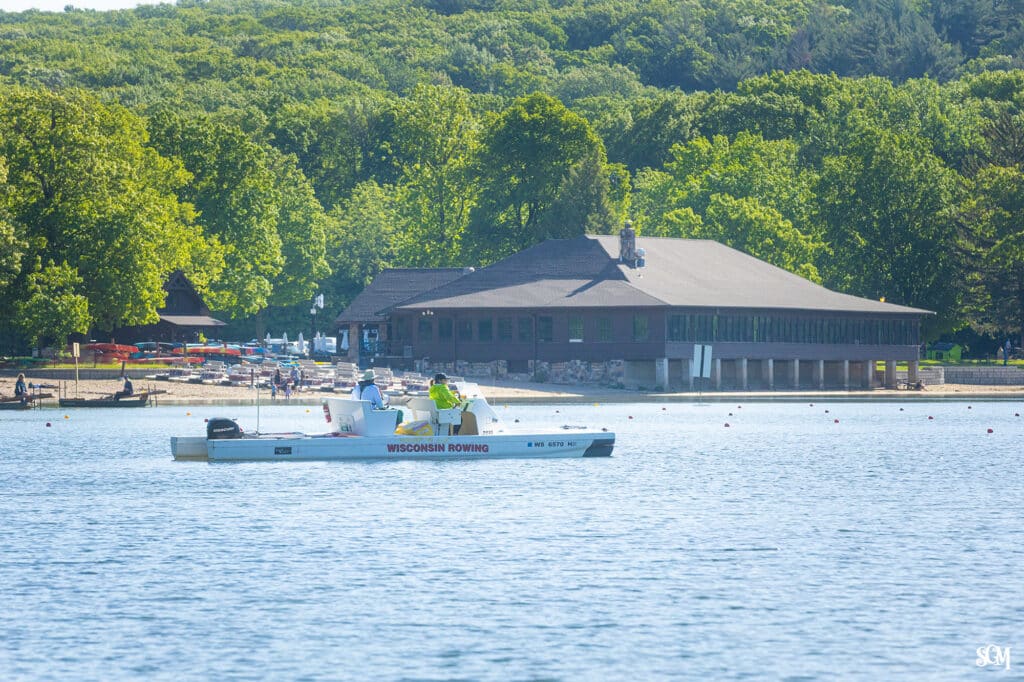
Beyond recreational use, several categories of gas-powered vessels operate on Devil’s Lake under the restriction:
- The park concessions operation keeps a gas-powered boat on the water to recover loose rental boats, restock equipment, and assist customers.
- Park wardens operate gas-powered craft for patrol and enforcement.
- DNR scientific crews and researchers may operate motorized vessels when their work requires it.
- Sanctioned events, including regattas, can bring gas-powered vessels onto the water under permit.
These are operational and authorized uses, not exceptions to the ban. They have been part of how the park functions for as long as the restriction has been in place.
A note on the commonly cited 1963 date
A 2013 article in the Baraboo News Republic references a 1963 announcement by park manager Edgar Trecker that motorboats would be banned at the end of the 1964 season. That article is frequently cited and surfaces prominently in search results.
As far as primary records show, no documentation corroborates that a ban took effect in 1964 or held through the late 1960s. Witness accounts of waterskiing at the park in the early 1970s are inconsistent with an effective ban during that period. The earliest primary source record placing a formal, board-approved ban was on March 7, 1972 — documented by the park’s own naturalist.
The 1963 announcement may reflect an intention that was not implemented, was later rescinded, or was not enforced. We are not able to fully account for the gap with available records. If you have documentation from the intervening period, we welcome it.